History of Joshua M Nkomo — “Father Zimbabwe”
(Former nationalist leader and Vice-President of Zimbabwe)
Born in 1918
Born on June 17, 1918 to black missionary teachers in the arid Semokwe reserve of south west Matebeleland, he was educated in South Africa. It was when he was studying in South Africa that he met some of the influential leaders of the African National Congress (ANC) whose ideas influenced and sharpened his future political career. It was during this time that he met Nelson Mandela and other regional nationalist leaders.
Returning to Bulawayo, 1948
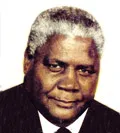
After returning to Bulawayo in 1948, he was employed as a social worker with the Rhodesia Railways. He was the first African to be appointed to such a prestigious post during that time. While working for the railways, he enrolled for a Bachelor of Arts degree in economics and sociology with UNISA., he became a trade unionist for black railway workers.
Because of his anti-tribalist approach to the liberation of his country, Nkomo earned the respect of all his countrymen, earning himself respectable names like Chibwechitedza, Father Zimbabwe, Umdala Wethu and others. These are revered titles in Zimbabwean history.
ZAPU, 1962
He founded a number of small organisations, all banned by the British colonial authorities, before founding ZAPU in 1962. It was immediately banned. Nkomo, frustrated with the lack of progress in negotiations with authorities, subtle indifference from the international community and the constant banning of liberation movements, decided to form a government in-exile as a way of stepping up international pressure on the colonial regime and effect political change in Southern Rhodesia. His ideas came under heavy criticism from Robert Mugabe his Secretary General, Julius Nyerere, then president of Tanzania, and his once trusted friend, Ndabaningi Sithole, who it seems were now becoming alarmed by Nkomo’s popularity at home and abroad. ZAPU split along ethnic grounds a year after its formation, with Robert Mugabe breaking away with the Shona majority (85 % of the total population of Rhodesia), forming Zanu-PF, leaving ZAPU as a mostly Ndebele organisation (15% of the total population of Rhodesia).
Ten years at Gonakudzingwa
On the 16th of April 1964, Nkomo was arrested, detained and spent the next ten and half years in prison at Gonakudzingwa. On his release in 1974, Nkomo quickly moved back to the centre stage of the Zimbabwe liberation struggle, chanting his ‘song’, one-man one-vote. Nkomo upon release, fled to Zambia to fight for Zimbabwean independence.
The 1980 elections
Elections were held in 1980, and to most observers surprise Nkomo’s ZAPU lost to Mugabe’s ZANU. During the 1980 elections ZANU PF largely played the tribal card to make sure Joshua Nkomo did not win the election despite his popularity. Nkomo was offered the ceremonial post of President, but declined. He was appointed to the cabinet, but in 1982 was accused of plotting a coup. His passport was seized and he was restricted to his Bulawayo home. Nkomo, with the help of his supporters in his home area, soon sneaked out of his restriction in Bulawayo and Zimbabwe through the Botswana border to Britain.
Gukurahundi
Mugabe unleashed the notorious Fifth Brigade upon Nkomo’s Matebeleland homeland. The Korean-trained Fifth Brigade popularly known as Gukurahundi, was sent into Matebeleland to deal with what were known as dissidents. The army killed thousands of civilians in Matebeleland as they claimed they were containing armed insurgents. The killings ended in 1987 when ZAPU agreed to a Unity Accord with ZANU.
Reconciled, 1987
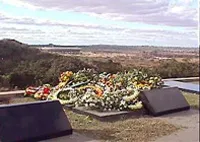
In 1987 Nkomo was reconciled with Mugabe and two parties merged, leaving Zimbabwe as effectively a one-party state, and leading some Ndebeles to accuse Nkomo of selling out.
Non-tribalism
Throughout his political career he preached the simple gospel of non-tribalism, racial mix, equal opportunities and equal distribution of land among the whites and dispossessed blacks.
He was convinced that when the land imbalance was corrected, every one in Zimbabwe would be uplifted socially and economically. He was the Vice-President of Zimbabwe until his death on the 4th of July 1999.
Do you know more about this? Corrections, photographs and your own account are all welcome, and a correction is published on the page with the date it was made. Send something in.